Helping People Discover Their Best Options Through...

The Rebe Homes Team helps our clients by providing...

Information with clear interpretation,
Judgment rooted in experience,
Insight that protects,
Conscious guidance based on integrity,
Meaning behind every decision,
Inspiration that encourages,
Relationships with service.

Thursday, January 28, 2016

Should I Buy Now Or Wait Until Next Year?

Should I Buy Now Or Wait Until Next Year? [INFOGRAPHIC] | Keeping Current Matters

  • The Cost of Waiting to Buy is defined as the additional funds it would take to buy a home if prices & interest rates were to increase over a period of time.
  • Freddie Mac predicts interest rates to rise to 4.8% by next year.
  • CoreLogic predicts home prices to appreciate by 5.3% over the next 12 months.
  • If you are ready and willing to buy your dream home, find out if you are able to!

Thursday, January 21, 2016

Should You Treat Your New Year’s Resolution Like a Game?


Should You Treat Your New Year’s Resolution Like a Game? 

I’ve heard it said, when you're shooting basketball free throws during practice, you shoot with skill. When you're shooting free throws during a game, you think about your aim. And when you're shooting free throws in overtime, you're a nervous wreck. Your skill is the same in all three cases - but because one goal means more to you than another, you let outside considerations weigh on your mind. A person who looks too hard at the outside gets clumsy on the inside.

To make sure you achieve your New Year’s resolution gracefully, ask yourself these four questions:

1. Am I focused on what I want? 

Your goal must be something you want for yourself. Are you defining your goal as something you want or something you are trying to avoid? You’re more likely to experience happiness by adding pleasure into your life instead of simply omitting pain.

2. Do I need help to achieve my goal or can I do it all by myself? 

If your resolution requires help from even one other person your goal can become limited by the energy or motivation of another person involved. Keep 100 percent control of your goal and only YOU decide when you’ll achieve it.

3. Is this something I must do now?

Experience shows if your goal can wait, it will. Explore the conditions necessary to move yourself into action and stay there. Imagine what will happen to the people you care about if you don’t follow through now.

4. Is it going to be worth it? 

It’s great if your goal can be fun like a game. Often times things worth doing aren’t fun or easy at first, but things that are worth it feel like they were easier when you’re done.

Achieving big goals that are worth it is like playing on a basketball team, you win or lose together and some of the most important moments are decided when you are at the free-throw line. 

Allen and Beth Rebenstorf
Rebe Homes Team!
480-236-8760
602-418-4202


Monday, January 4, 2016

Don’t Let Rising Rents Trap You!

Don't Let Rising Rents Trap You! | Keeping Current Matters

There are many benefits to homeownership. One of the top ones is being able to protect yourself from rising rents and lock in your housing cost for the life of your mortgage.

Don’t Become Trapped

Jonathan Smoke, Chief Economist at realtor.com recently reported on what he calls a “Rental Affordability Crisis”. He warns that,

“Low rental vacancies and a lack of new rental construction are pushing up rents, and we expect that they’ll outpace home price appreciation in the year ahead.”

The Joint Center for Housing Studies at Harvard University recently released their 2015 Report on Rental Housing, in which they reported that 49% of rental households are cost-burdened, meaning they spend more than 30% of their income on housing. These households struggle to save for a rainy day and pay other bills, such as food and healthcare.

It’s Cheaper to Buy Than Rent

In Smoke’s article, he went on to say,

“Housing is central to the health and well-being of our country and our local communities. In addition, this (rental affordability) crisis threatens the future value of owned housing, as the burdensome level of rents will trap more aspiring owners into a vicious financial cycle in which they cannot save and build a solid credit record to eventually buy a home.”

 “While more than 85% of markets have burdensome rents today, it’s perplexing that in more than 75% of the counties across the country, it is actually cheaper to buy than rent a home. So why aren’t those unhappy renters choosing to buy?”

Know Your Options

Perhaps, you have already saved enough to buy your first home. HousingWire reportedthat analysts at Nomura believe:

“It’s not that Millennials and other potential homebuyers aren’t qualified in terms of their credit scores or in how much they have saved for their down payment.

It’s that they think they’re not qualified or they think that they don’t have a big enough down payment.” (emphasis added)

Many first-time homebuyers who believe that they need a large down payment may be holding themselves back from their dream home. As we reported last week, in many areas of the country, a first-time home buyer can save for a 3% down payment in less than two years. You may have already saved enough!

Bottom Line


Don’t get caught in the trap so many renters are currently in. If you are ready and willing to buy a home, find out if you are able. Have a professional help you determine if you are eligible to get a mortgage.

Building Family Wealth Over The Next 5 Years

Building Family Wealth Over The Next 5 Years | Keeping Current Matters

As the economy continues to improve, more and more Americans are seeing their personal financial situations also improving. Instead of just getting by, many are now beginning to save and find other ways to build their net worth. One way to dramatically increase their family wealth is through the acquisition of real estate.

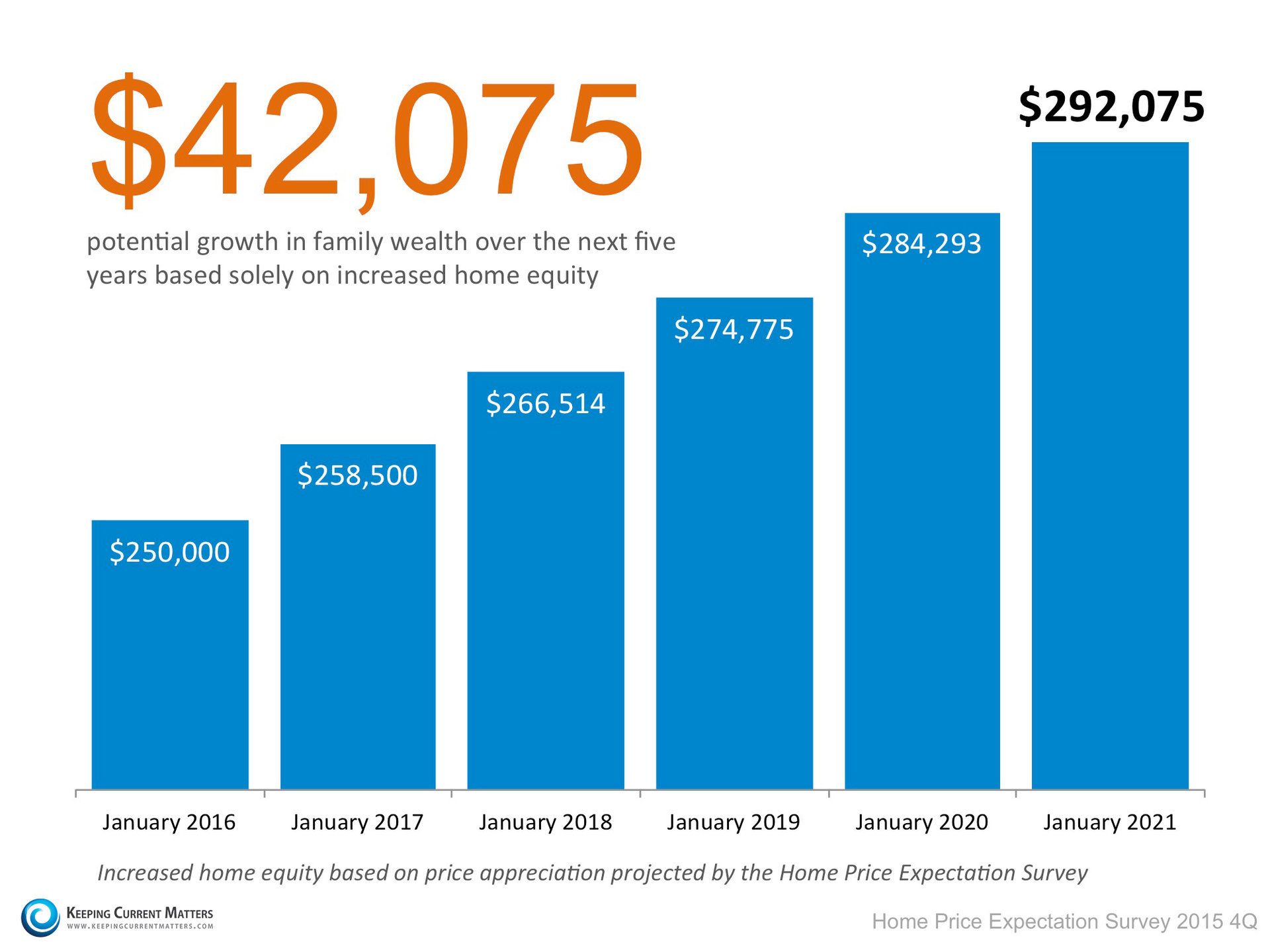
For example, let’s assume a young couple purchases and closes on a $250,000 home in January. What will that home be worth five years down the road?

Pulsenomics surveys a nationwide panel of over one hundred economists, real estate experts and investment & market strategists every quarter. They ask them to project how residential prices will appreciate over the next five years. According to their latest survey, here is how much value that $250,000 house will gain in the coming years.

Family Wealth Earned with Home Equity | Keeping Current Matters

Over a five year period, that homeowner can build their home equity to over $40,000. And, in many cases, home equity is large portion of a family’s overall net worth.

Bottom Line


If you are looking to better your family’s long-term financial situation, buying your dream home might be a great option.

Home Prices: Where Are They Headed Over The Next 5 Years?

Home Prices: Where Are They Headed Over The Next 5 Years? | Keeping Current Matters

Today, many real estate conversations center on housing prices and where they may be headed. That is why we like the Home Price Expectation Survey.

Every quarter, Pulsenomics surveys a nationwide panel of over one hundred economists, real estate experts and investment & market strategists about where they believe prices are headed over the next five years. They then average the projections of all 100+ experts into a single number.

The results of their latest survey:

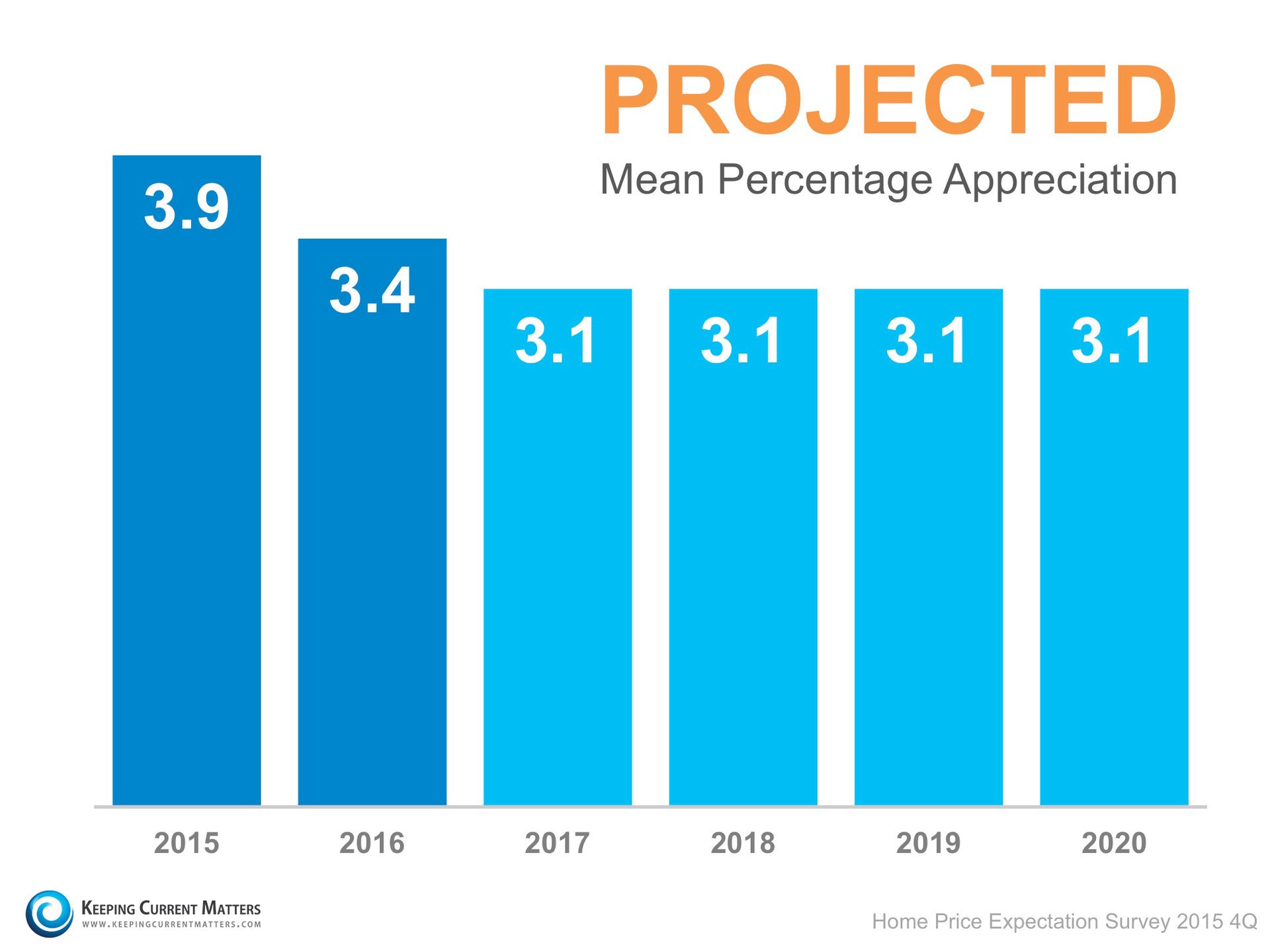
Home values will appreciate by 3.9% by the end of 2015, 3.4% in 2016 and 3.1% in each of the following four years (as shown below). That means the average annual appreciation will be 3.2% over the next 5 years.

Projected Mean Appreciation | Keeping Current Matters

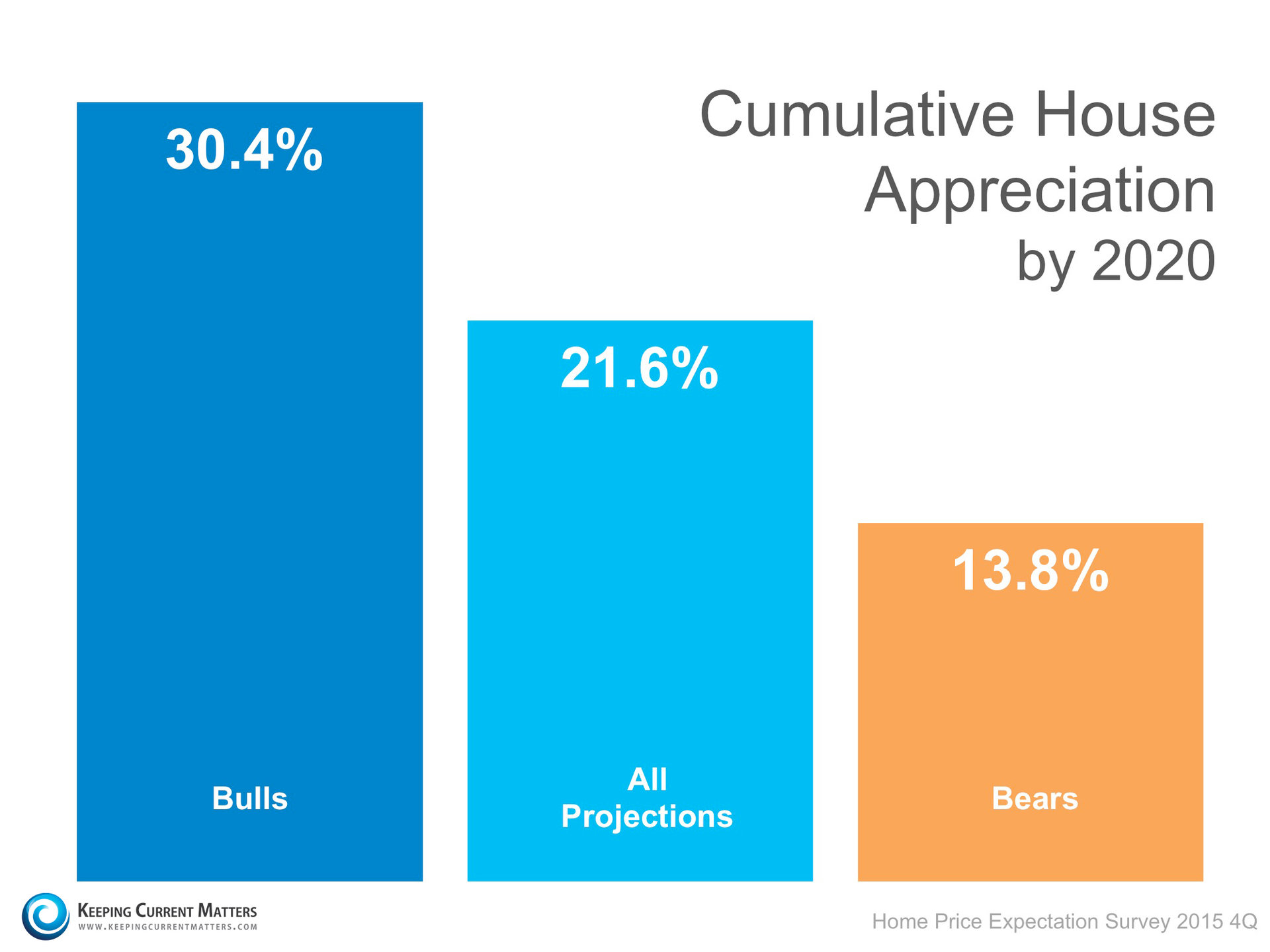
The prediction for cumulative appreciation rose from 18.1% to 21.6% by 2020. Even the experts making up the most bearish quartile of the survey still are projecting a cumulative appreciation of 13.8%.

Cumulative House Appreciation | Keeping Current Matters

Bottom Line


Individual opinions make headlines. We believe the survey is a fairer depiction of future values.

FSBO, List Again or OTM? A Seller’s Dilemma

FSBO, List Again or OTM? A Seller's Dilemma | Keeping Current Matters

At the end of December, in every region of the country, hundreds of homeowners have a tough decision to make. The ‘listing for sale agreement’ on their house is about to expire and they now must decide to either take their house off the market (OTM), For Sale by Owner (FSBO) or list it again with the same agent or a different agent.

Let’s assume you or someone you know is in this situation and take a closer look at each possibility:
Taking Your Home off the Market

In all probability, after putting your house on the market and seeing it not sell, you’re going to be upset. You may be thinking that no one in the marketplace thought the house was worthy of the sales price.

Because you are upset, you may start to rationalize that selling wasn’t that important after all and say,
“Well, we didn’t really want to sell the house anyway. This idea of making a move right now probably doesn’t make sense.”

Don’t rationalize your dreams away. Instead, consider the reasons you decided to sell in the first place. Ask your family this simple question:

“What made us originally put our home up for sale?” 

If that reason made sense a few months ago when you originally listed the house, chances are it still makes sense now. Don’t give up on what your family hoped to accomplish or on goals your family hoped to attain.

Just because the house didn’t sell during the last listing contract doesn’t mean the house will never sell or that it shouldn’t be sold.

Re-Listing with your Existing Agent

For whatever reason, your house did not sell. Perhaps you now realize how difficult selling a house may be or that the listing price was too high, or perhaps you’re now acknowledging that you didn’t exactly listen to your agent’s advice.

If that is the case, you may want to give your existing agent a second chance. That’s a perfectly okay thing to do.

However, if your agent didn’t perform to the standard they promised when they listed your home you may want to either FSBO or try a different agent.

For Sale by Owner

You may now believe that listing your house with an agent is useless because your original agent didn’t accomplish the goal of selling the house. Trying to sell the house on your own this time may be alluring. You may think you will be in control and save on the commission.

But, is that true? Will you be able to negotiate each of the elements that make up a real estate transaction? Are you capable of putting together a comprehensive marketing plan? Do people who FSBO actually ‘net’ more money?

If you are thinking about FSBOing, take the time to first read: 5 Reasons You Shouldn’t For Sale by Owner.

List with a New Agent

After failing to sell your home, you may no longer trust your agent or what they say. However, don’t paint all real estate professionals with that same brush. Have you ever gotten a bad haircut before? Of course! Did you stop getting your hair cut or did you simply change hair stylists?

There is good and bad in every profession—good and bad hair stylists, agents, teachers, lawyers, doctors, police officers, etc. And just because there are good and bad in every line of work doesn’t mean you don’t call on others for the products and services you need. You still get your haircut, see a doctor, talk to a lawyer, send your kids to school, etc.

Bottom Line


You initially believed that using an agent made sense. It probably still does. Contact a local real estate professional and discuss the possibilities.

How Long Does It Take To Save A Down Payment?

How Long Does It Take To Save A Down Payment? | Keeping Current Matters

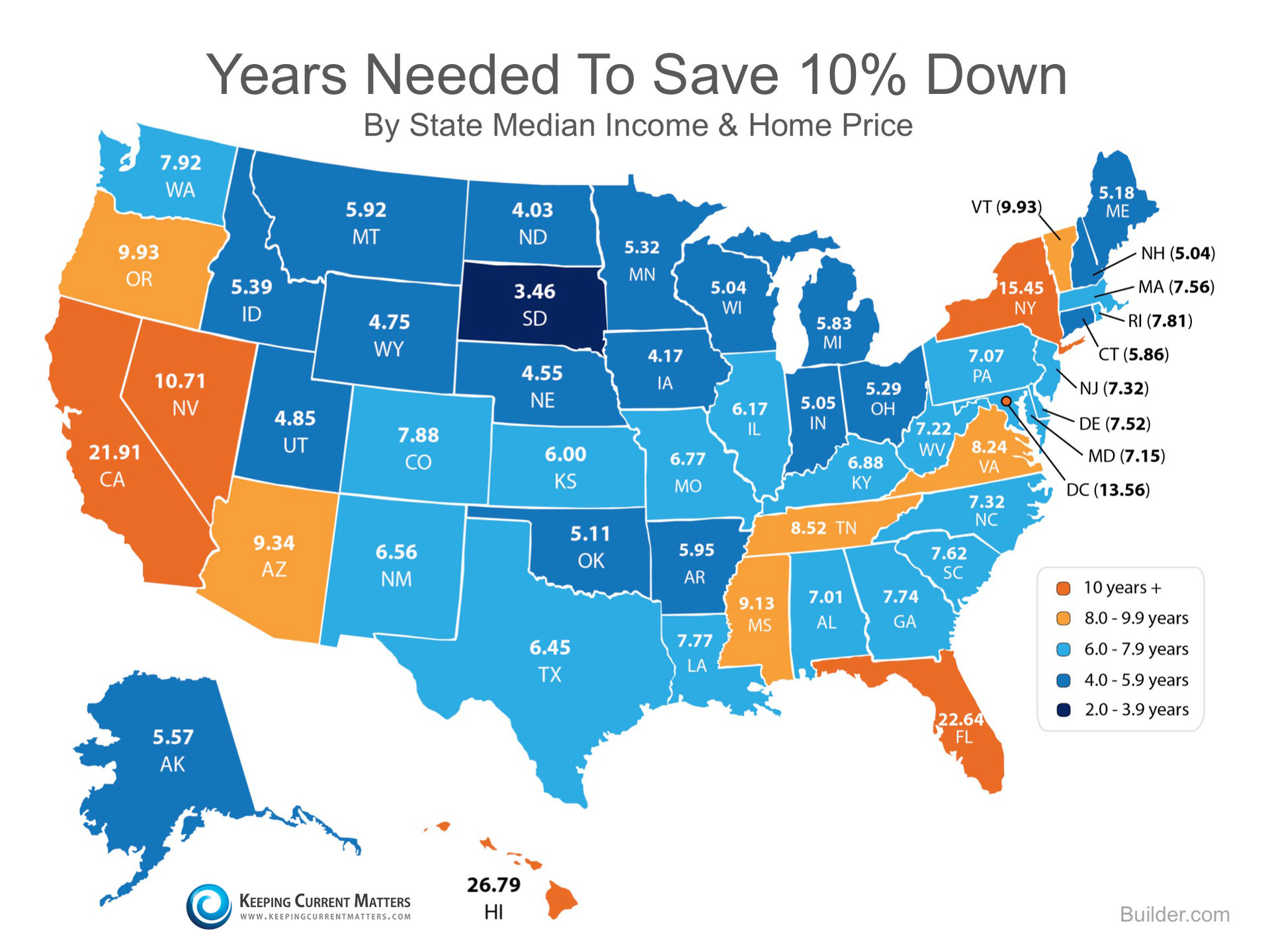
In a recent study conducted by Builder.com, researchers determined that nationwide it would take “nearly eight years” for a first-time buyer to save enough for a down payment on their dream home.

Depending on where you live, median rents, incomes and home prices all vary. By determining the percentage a renter spends on housing in each state and the amount needed for a 10% down payment, they were able to establish how long (in years) it would take for an average resident to save.

According to the study, residents in South Dakota are able to save for a down payment the quickest in just under 3.5 years. Below is a map created using the data for each state:

Years Needed to Save 10% Down | Keeping Current Matters

What if you only needed to save 3%?

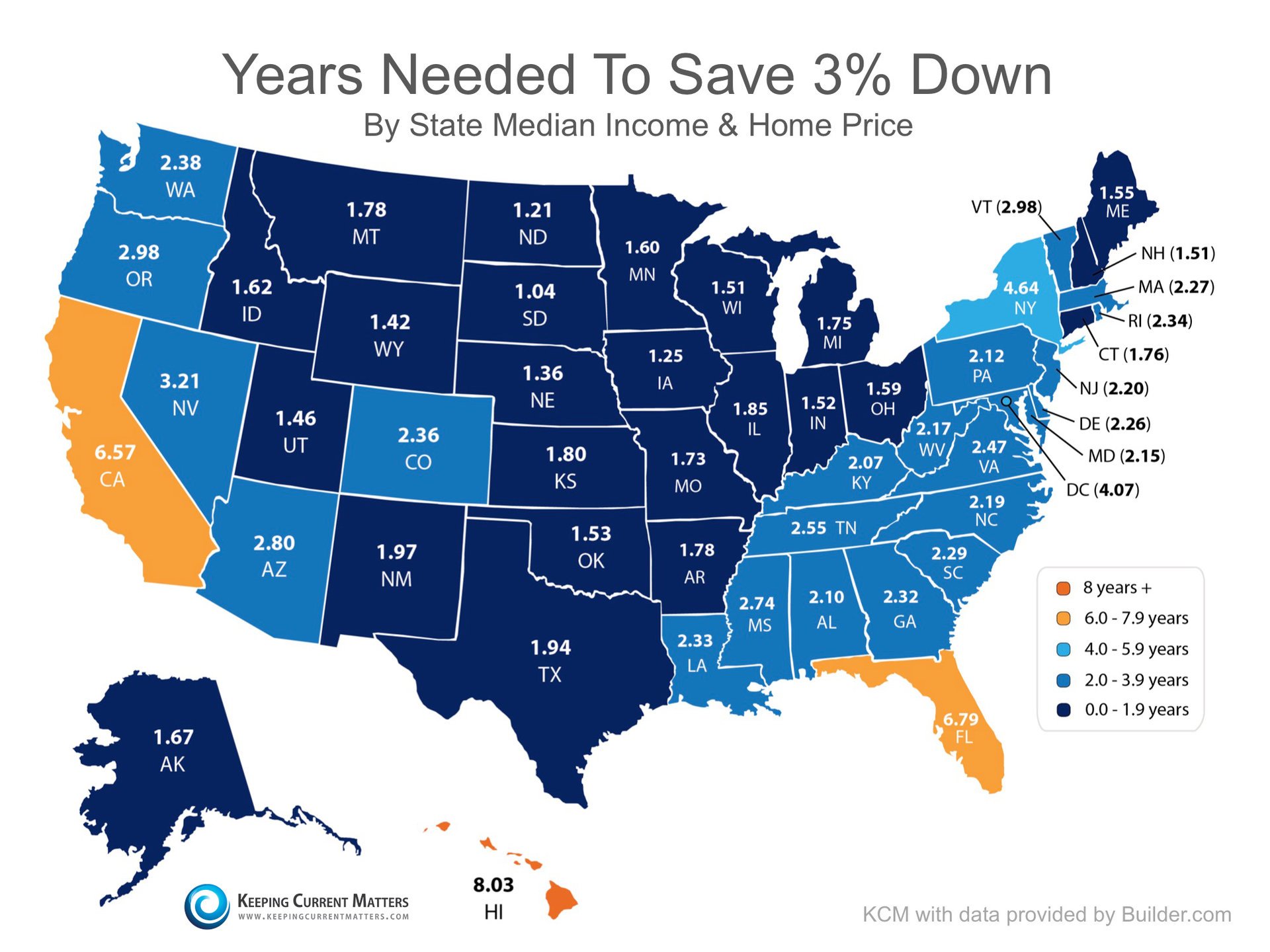
What if you were able to take advantage of one of the Freddie Mac or Fannie Mae 3% down programs? Suddenly saving for a down payment no longer takes 5 or 10 years, but becomes attainable in under two years in many states as shown in the map below.

Years Needed to Save 3% Down | Keeping Current Matters

Bottom Line


Whether you have just started to save for a down payment, or have been for years, you may be closer to your dream home than you think! Meet with a local Rebe Homes professional who can help you evaluate your ability to buy today.